

2019: China’s First “Industry-Internet” IPO Debuts with a Market Cap over RMB 3 Billion
At 9:30 a.m. on July 30, Beijing United Information Technology Co.,Ltd (stock short name: IBI, stock code: 603613) rang the opening bell on the Shanghai Stock Exchange. The IPO issue price was RMB 15.13, with a P/E ratio of 22.98. Shares closed the first day at RMB 27.79, up 44%, bringing the market capitalization to RMB 3.068 billion—marking the birth of China’s first Industry-Internet stock in 2019.
IBI is an industry-internet platform built on Industrial E-commerce and powered by internet data. According to its prospectus, the company posted RMB 3.6 billion in revenue and RMB 108 million in net profit in 2018. From 2015 to 2018, operating revenue and net profit registered CAGRs of 162.64% and 107.95%, respectively.
Through its B2B vertical e-commerce platforms—Toodudu (TDD), Wdoodoo (WDD), and Boododo (BDD)—IBI provides online merchandise transactions for upstream and downstream players in coatings & chemicals, hygiene products, and glass. At the same time, it uses order-driven operations to connect factories on both ends of the chain into its SaaS systems, with the goal of building an efficient, professional industry-internet system rooted in vertical supply chains.
Linking upstream factories with fragmented downstream buyers (SME plants), IBI delivers supply-chain services driven by orders—typical of a “middle-chain” enterprise (a digital supply-chain platform connecting manufacturers and enterprise end-users).
IBI’s path to the industry internet moves from industrial e-commerce to free, in-depth SaaS services that capture transaction and production data, then to smart-factory solutions and vertical industrial-internet services.
Example: One of IBI’s core categories is titanium dioxide (TiO₂)—a must-have raw material for coatings, inks, paper, and plastics. The industry’s upstream is relatively concentrated (some 30+ plants nationwide), while the downstream is highly fragmented and channel-driven with many trading layers—fertile ground for industry-internet transformation.
From Information Services to Vertical E-commerce
Founded in 2002, IBI now operates three major B2B vertical e-commerce platforms. Online merchandise transactions comprise self-operated e-commerce, third-party marketplace, and SaaS services. From 2015 to 2018, online transactions accounted for 88%, 92%, 96% of revenue, respectively. Before TDD launched in 2014, IBI mainly earned membership-based information-service fees.

IBI Resource Network went online in 2006 as a sector-based B2B information portal (like many 2B sites of that era). It now covers 100+ industries, with 2 million registered corporate members, 200,000 active members, a 10-million-entry company yellow-pages database, and 50 million bidding/tender information records—monetized via memberships.
As information asymmetry eased and homogeneity intensified, pure matchmaking services hit a ceiling around 2011–2013. With big data, cloud computing, and IoT maturing—and with shifts in economic/industry cycles—B2B 2.0 (online transactions + SaaS) arrived in 2014 and entered a high-growth phase in 2015. IBI seized the moment to upgrade from information services to vertical e-commerce, leveraging its deep accumulation to select large-space sectors suited for online transactions where it held resource and team advantages—starting with coatings/chemicals, hygiene, and glass.
“One Core, Two Wings” Strategy
In 2015, IBI launched Toodudu (TDD) (later app + mini-program), using its strengths in TiO₂ and other categories to run self-operated industrial raw-material e-commerce (think “JD.com for industrial inputs”), then added third-party marketplace (JD POP-style). Together with WDD (hygiene) and BDD (glass & products), these became the three pillars.
More precisely, IBI follows “one core, two wings.”

-
Core = Data. Duoduo e-commerce (TDD/WDD/BDD) connects factory production via SaaS, capturing transaction and production data—the core asset. On vertical chains and industrial big data, IBI offers customized smart-factory solutions and links these factories on platform to form an efficient industry-internet system.
Industry data: Based on platform transactions and aggregated buy/sell price data, TDD compiles titanium-chain indices (TiO₂, titanium materials, TiCl₄, ilmenite, high-Ti slag, rutile), weekly briefs, maps, capacity/output reports, etc.
-
Wing 1 = Smart Logistics. Traditional multi-tier, fragmented, offline logistics can’t scale, leading to high costs/low efficiency. IBI aggregates fragmented orders; uses central warehouses, forward warehouses, containers (“box as warehouse”) to move inventory upstream and shorten days-on-hand; and boosts last-mile efficiency via a cloud-warehouse system. (E.g., TiO₂ forward warehouses in Guangdong; ilmenite central warehouse at Huanghua Port.)
-
Wing 2 = Industrial Fund. Leveraging platform influence, IBI co-builds funds with industry partners and financial institutions to deeply integrate procurement, production, sales, logistics, after-sales with new tech/models—investing in digital smart factories and advanced upstream capacity in the titanium chain.
Upstream & Downstream Playbooks
On this strategy, IBI’s monetization logic centers on tactics for both ends:
Upstream: Select mid-sized producers as core suppliers, provide amplified online marketing, and channel concentrated orders so platform sales gradually exceed 15% of a supplier’s annual output on average. Rising influence secures stable supply and better pricing.
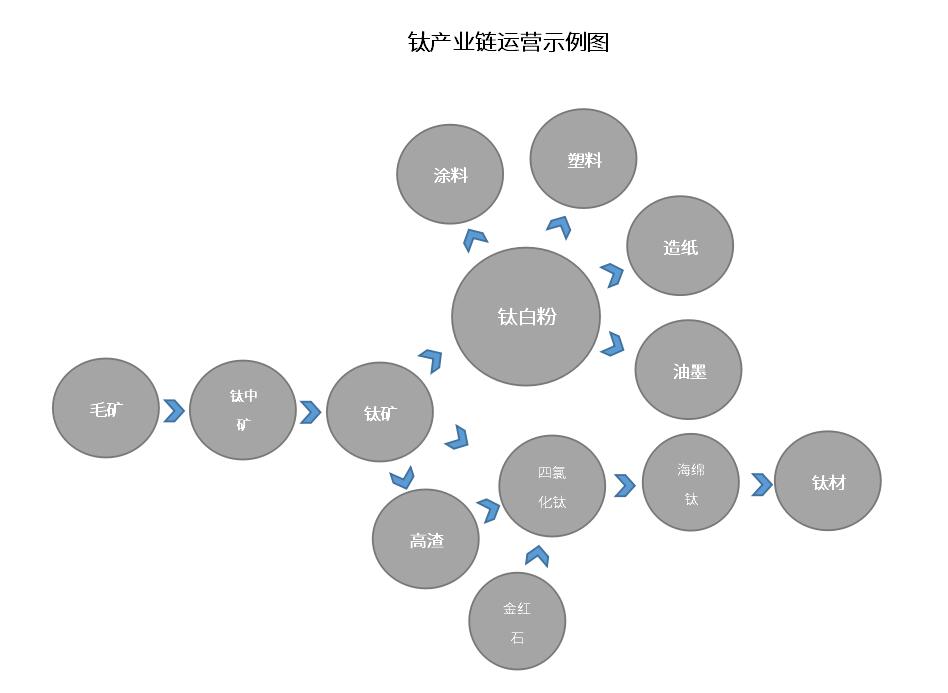
IBI also extends along the supply chain. For example, beyond selling TiO₂, TDD supplies its upstream raw materials—ilmenite, rutile, Ti-slag—sourcing from Panzhihua/Xinjiang (China), Vietnam, Australia, India, etc., via grouped orders to serve TiO₂ producers. Organizing upstream resources strengthens supply assurance and supplier stickiness. Moving further upstream increases control and bargaining power; each tier aggregates orders to negotiate better and sells directly online to keep the chain lean and supply stable.
Downstream: Early on, focus on a single-product breakthrough instead of chasing SKU count. Given concentrated upstream power and fragmented downstream SMEs with weaker bargaining power, IBI uses group-buying (collection) procurement to aggregate many small orders into large ones—turning many small Bs into one big B (“industrial raw-material group-buy”).
Once the single-product wedge takes hold, IBI extends categories to meet the same customer’s broader raw-material needs and build one-stop sourcing.
Because regional distributors possess local end-customer bases and last-mile capabilities (storage, delivery, testing, commercial, after-sales), while IBI cannot instantly build nationwide last-mile service, it partners with sub-terminal traders to fill that gap efficiently.
Order-Driven Digitization
The U.S. has a dozen 2B giants worth $100B+ (Oracle, Salesforce, Sysco, etc.), while China has yet to birth one. As Ebrun CEO Zheng Min notes, “Such giants must integrate across an industry chain”—and the driver of integration is orders.
Many SME factories are still under-digitized (e.g., leaders still hand-sign key contracts). They grasp the value of digitalization but hesitate to invest. IBI’s solution: bring orders to promote free SaaS.
IBI provides free cloud-ERP to registered suppliers/buyers—covering inventory, sales, finance, CRM, office—and requires both sides to process orders within the ERP, sharply improving transaction efficiency and platform governance.