

AI Empowers the Industrial Internet, Opening a New Chapter in Industrial Digitalization
As a platform dedicated to the exploration of the industrial internet, IBI builds on industrial e-commerce, supported by internet big data. The company is committed to the deep integration of new technologies—such as the internet, IoT, big data, cloud computing, and artificial intelligence—with traditional industries, striving to continuously promote cost reduction and efficiency improvement in conventional sectors.
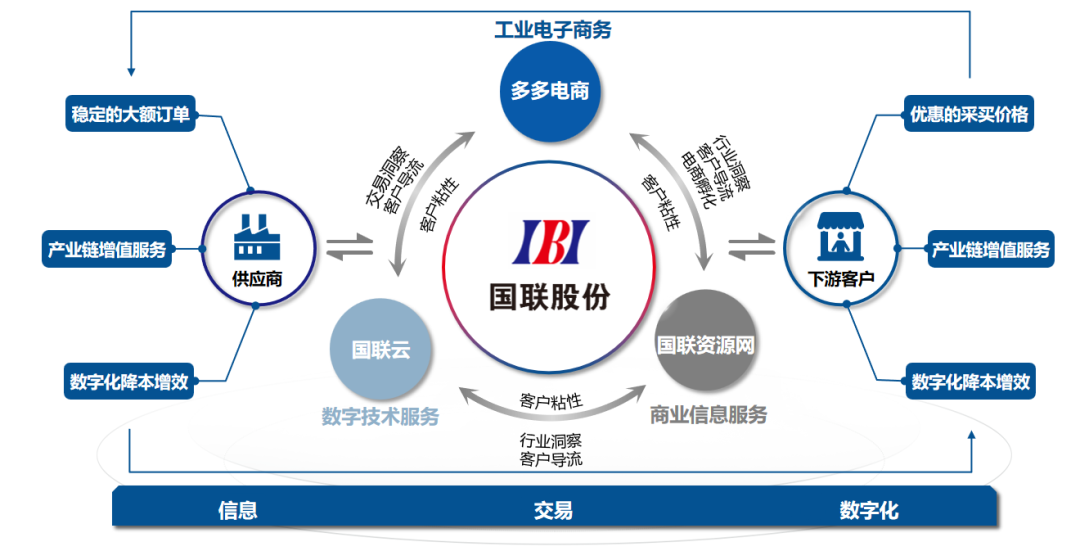
According to the Ministry of Industry and Information Technology (MIIT), industrial e-commerce is a crucial part of the industrial internet and an effective means of advancing the pragmatic development of industrial internet platforms. The core of the industrial internet lies in “connectivity,” while the core of industrial e-commerce lies in “commerce.” Industrial internet connects machines and equipment, generating vast data streams; industrial e-commerce, centered on supply chains, forms closed loops of information flow, business flow, logistics, and capital flow. This enables value-added transformation—from connectivity to data-driven value, from connectivity to supply chain value, and from connectivity to cross-sector ecosystems—thus becoming an essential driver for the industrial internet’s deep integration.

The core of IBI’s industrial internet strategy is “platform services, technology-driven, data-supported.” Through platform, technology, and data, IBI is constructing a new vertical industrial internet ecosystem. Over the years, the company has continuously advanced stage-by-stage strategies beginning with industrial e-commerce. Through platform operations, IBI fulfills the operational needs of enterprises in transactions, delivery, capital, production, and connections. With digital transaction tools, supply chain digitalization tools, and production operation digital tools, it has built a technology-driven system to support platform operations. As platforms operate, technology drives digital transformation of supply chains and production, generating massive data at transaction, supply chain, and production ends. This data forms the backbone for industrial internet operations, realizing the core value of industrial connectivity—using data to link multiple industrial segments, ultimately achieving value enhancement and cost efficiency.
The application of AI in the industrial internet, as industrial transformation deepens, will likely exhibit two characteristics:
1. Based on massive data collection and powered by machine learning or deep learning algorithms, AI will build models to solve diagnostic and predictive problems.
2. Driven by user needs, AI will achieve full value-chain coverage, providing decision-making support for production control optimization, supply chain optimization, logistics scheduling, and market sales forecasting.
Artificial intelligence enhances the real economy across all stages. In manufacturing, for example, AI improves production processes such as automated sorting, quality inspection, equipment operation, and process optimization. While “intelligent connectivity” has already proven its value, successful implementation requires both platforms and ecosystems. AI must sense users, enable natural interaction, and connect with devices through software and services integrated with the cloud. In this sense, industrial internet platforms themselves serve as both carriers and ecosystems.
IBI’s Practices in AI
We believe AI technology is one of the key means to optimize production efficiency and innovate business models. In recent years, IBI has conducted extensive research and applications in AI, particularly in smart recommendations, sales forecasting, procurement forecasting, and machine vision on its e-commerce platforms.
1. Smart Recommendation
To better meet diverse user needs, we have adopted deep learning algorithms that analyze user data such as click history, purchase records, preferences, and tags to provide personalized recommendations. This improves satisfaction and conversion rates. Beyond product recommendations, similar algorithms are applied in industrial production—for example, recommending raw material ratios, operational adjustments in DCS systems, or optimal routes and freight cost predictions in bulk logistics.
2. Sales and Procurement Forecasting
With abundant industrial data, including industry information, production capacity distribution, transactions, customers, production, and logistics, IBI trains models to predict market demand and supply for the next 1–3 months. Accurate forecasts enable better product portfolio optimization and supply chain management, helping customers respond effectively to market changes.
3. Safety Monitoring in Digital Cloud Factories/Warehouses
Since 2021, IBI has been implementing its “Three-Year Hundred Cloud Factories” plan. Through machine vision, cameras, and sensors monitor production processes, worker behavior, warehouse anomalies, and fire risks. By deploying AI video analysis at the edge, factories can improve safety, detect risks such as abnormal temperatures, fire, smoking, and equipment malfunctions, thus ensuring more intelligent and efficient production management.
4. Industrial Metaverse — Yuanqi
Yuanqi is IBI’s industrial metaverse project, designed to provide massive simulation data for machine vision model training. Traditional machine vision struggles with data collection, but the metaverse generates high-quality training data through simulation environments and game engines, enabling accurate models for object detection, segmentation, and safety monitoring. It also creates complex dynamic scenarios such as traffic or crowd density, enhancing predictive and early-warning capabilities.
5. Integration with ChatGPT
IBI has fully integrated ChatGPT into its internal management platform, enabling employees to use it for tasks such as writing code, generating database structures, automated testing, and content creation. Product and technology teams leverage it for system design and development; video teams use it for script writing; and sales/customer service staff for refining communication. Meanwhile, IBI is also actively connecting with Baidu’s Ernie Bot and Alibaba Cloud’s Tongyi Qianwen to build AI applications for Duoduo platforms and their upstream/downstream partners.
Future Outlook
Although AI has increasingly penetrated industrial design, production, management, marketing, and sales, its overall adoption remains at an early stage with relatively low application ratios and high costs. For example, building a model often requires multi-million-yuan investments, driven by the shortage of AI professionals in China and overheated market demand. IBI aims to lower the threshold for AI adoption across industries, making AI accessible to traditional sectors to boost efficiency and create more value for enterprises.
In our view, the industrial internet is an open framework that can integrate various advanced technologies—AI, blockchain, cloud computing, big data, and GPT. As a driver of the industrial internet, IBI will continue to embrace AI and other new technologies in advancing industrial digitalization, promoting the integration of emerging technologies with traditional industries, and facilitating industrial and supply chain upgrades.