

IBI Invited to Attend the Opening Ceremony of the Forum on China–Africa Cooperation (FOCAC) Beijing Summit
On September 5, 2024, Qian Xiaojun, Founder, CEO, and President of IBI, was invited to attend the opening ceremony of the Forum on China–Africa Cooperation (FOCAC) Beijing Summit.
Lead:
On the morning of September 5, President Xi Jinping attended the opening ceremony of the Beijing Summit of the Forum on China–Africa Cooperation at the Great Hall of the People in Beijing and delivered a keynote speech. Xi announced that China will elevate bilateral relations with all African countries having diplomatic relations with China to the strategic level, and will upgrade the overall positioning of China–Africa relations to an all-weather China–Africa community with a shared future in the new era. China will implement the Ten Partnership Actions for China–Africa Modernization.
Li Qiang, Zhao Leji, Wang Huning, Cai Qi, Ding Xuexiang, and Li Xi, members of the Standing Committee of the Political Bureau of the CPC Central Committee, attended the opening ceremony.
Xi Jinping delivered a keynote speech entitled “Join Hands to Advance Modernization and Build a Community with a Shared Future.”
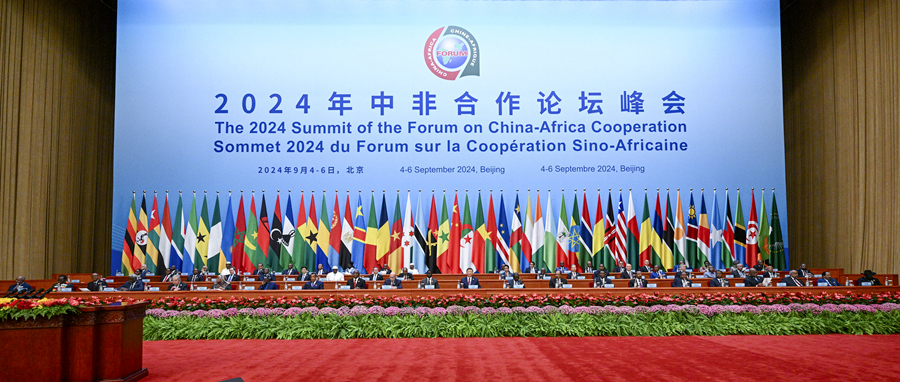
Xi pointed out that in this season of harvest, it is a great pleasure to meet old and new friends in Beijing to discuss the grand cause of China–Africa friendship and cooperation in the new era. The friendship between China and Africa has transcended time and space, crossed mountains and seas, and been passed down from generation to generation. Since the founding of the Forum on China–Africa Cooperation 24 years ago, especially in the new era, China and African brothers and sisters have, in the spirit of sincerity, real results, amity, and good faith, stood shoulder to shoulder and hand in hand in the face of the profound changes unseen in a century, firmly safeguarding each other’s legitimate rights and interests; strengthened themselves in the tide of economic globalization, achieving fruitful results that benefit hundreds of millions of Chinese and Africans; shared hardships in the face of major disasters and pandemics, writing many touching stories of China–Africa friendship; always understood and supported each other, and set an example for a new type of international relations. After nearly 70 years of hard work, China–Africa relations are now at their best in history. Looking ahead, China proposes to elevate bilateral relations with all African countries having diplomatic ties with China to the strategic level, and to upgrade the overall positioning of China–Africa relations to an all-weather China–Africa community with a shared future in the new era.
Xi stressed that modernization is an inalienable right of all countries. China is unwaveringly advancing the building of a strong country and the great rejuvenation of the Chinese nation through Chinese modernization. Africa is also steadily moving toward the modernization goals outlined in the African Union’s Agenda 2063. The joint pursuit of modernization by China and Africa will surely set off a wave of modernization across the Global South and write a new chapter in building a community with a shared future for mankind.
Xi proposed that China and Africa should join hands to advance the “Six Modernizations”:
1. Just and equitable modernization – Modernization should follow general laws and suit each country’s national conditions. China will strengthen governance experience exchange with Africa, support African countries in exploring modernization paths suited to their realities, and ensure equality in rights and opportunities.
2. Open and win–win modernization – Mutually beneficial cooperation is the bright path aligned with the long-term and fundamental interests of all countries. China will deepen cooperation with Africa in industry, agriculture, infrastructure, trade, and investment, set a benchmark for high-quality Belt and Road cooperation, and create a model for implementing the Global Development Initiative.
3. People-centered modernization – The ultimate goal is the free and all-round development of human beings. China will work with Africa to carry out cooperation in talent training, poverty reduction, and employment to improve people’s sense of gain, happiness, and security, ensuring modernization benefits all people.
4. Inclusive modernization – Achieving coordinated development of material and spiritual civilization is the lofty pursuit of modernization. China will enhance cultural exchanges with Africa, advocate mutual respect and coexistence among civilizations, and promote more fruits from the Global Civilization Initiative.
5. Eco-friendly modernization – Green development is a hallmark of modernization in the new era. China will help Africa build “green growth engines,” close the gap in energy accessibility, and jointly promote global green and low-carbon transformation.
6. Peaceful and secure modernization – Modernization requires a peaceful and stable environment. China will help Africa enhance its capacity for self-maintaining peace and stability, promote the implementation of the Global Security Initiative in Africa, and achieve positive interaction between high-quality development and high-level security.
Xi stressed that China and Africa together account for one-third of the world’s population; without the modernization of China and Africa, there will be no global modernization. Over the next three years, China is willing to work with Africa to advance the Ten Partnership Actions for China–Africa Modernization and lead the modernization of the Global South.
Ten Partnership Actions for China–Africa Modernization:
1. Civilization Mutual Learning Partnership Action – Build a governance experience exchange platform, establish a China–Africa Development Knowledge Network and 25 China–Africa research centers, and invite 1,000 African political party members to visit China.
2. Trade Prosperity Partnership Action – Expand market access by granting 100% tariff-free treatment to products from all least developed countries with diplomatic ties to China, including 33 African countries; expand African agricultural product imports; deepen cooperation in e-commerce; implement the China–Africa Quality Improvement Plan; negotiate an economic partnership framework agreement.
3. Industrial Chain Cooperation Partnership Action – Build industrial cooperation growth circles, establish China–Africa pilot zones for deep economic cooperation, launch the Africa SME Empowerment Program, and jointly establish a China–Africa Digital Technology Cooperation Center and 20 digital demonstration projects.
4. Connectivity Partnership Action – Implement 30 infrastructure connectivity projects in Africa, promote high-quality Belt and Road cooperation, develop a coordinated land–sea connectivity network, support the African Continental Free Trade Area, and deepen logistics and financial cooperation.
5. Development Cooperation Partnership Action – Release a joint statement under the Global Development Initiative framework, implement 1,000 “small yet smart” livelihood projects, fund the China–World Bank Partnership Facility, support the 2026 Youth Olympic Games and 2027 Africa Cup of Nations.
6. Health Partnership Action – Establish a China–Africa hospital alliance and joint medical centers, send 2,000 medical personnel, implement 20 health and anti-malaria projects, promote Chinese investment in pharmaceutical manufacturing, and support Africa CDC capacity building.
7. Agriculture and People’s Livelihood Partnership Action – Provide RMB 1 billion in emergency food aid, develop 100,000 mu of standardized agricultural demonstration zones, dispatch 500 agricultural experts, establish a China–Africa Agricultural Science and Technology Innovation Alliance, and create over 1 million jobs in Africa.
8. People-to-People Exchange Partnership Action – Advance the “Future Africa Vocational Education” plan, build engineering technology institutes and 10 Luban Workshops, offer 60,000 training opportunities, implement the China–Africa Cultural Silk Road Plan, and designate 2026 as the “Year of China–Africa People-to-People Exchanges.”
9. Green Development Partnership Action – Implement 30 clean energy projects in Africa, establish early warning meteorological platforms, conduct disaster prevention, mitigation, and biodiversity protection cooperation, and set up the China–Africa Peaceful Use of Nuclear Technology Forum.
10. Security Partnership Action – Establish a Global Security Initiative partnership, train 6,000 military personnel and 1,000 law enforcement officers, invite 500 young officers to visit China, conduct joint exercises and patrols, and carry out a “Help Africa Eliminate Landmines” initiative.
To promote the implementation of the “Ten Partnership Actions,” the Chinese government is willing to provide strong support for pragmatic cooperation between China and Africa in various fields.
President Xi Jinping concluded by stressing that the Third Plenary Session of the 20th Central Committee of the Communist Party of China (CPC) has made systematic arrangements for further deepening reform comprehensively and advancing Chinese modernization. This will further profoundly transform China, and will also provide new opportunities and inject new momentum for African countries and for China and Africa to jointly pursue the dream of modernization. There is an African proverb that says, “A companion on the same road is a true friend.” On the road to modernization, no one should be left behind, and no country should be left out. Let us unite the tremendous strength of over 2.8 billion people of China and Africa, walk hand in hand on the journey toward modernization, contribute China–Africa modernization to the modernization of the Global South, paint a brand-new chapter in the history of human development, and jointly promote the world toward a bright future of peace, security, prosperity, and progress.
President Faye of Senegal, co-chair country of the Forum on China–Africa Cooperation (FOCAC); President Ghazouani of Mauritania, current chair of the African Union (AU); sub-regional representatives President Ramaphosa of South Africa, President Sassou of the Republic of the Congo, President Tinubu of Nigeria, and President Hassan of Tanzania; summit special guest UN Secretary-General Guterres; and AU Commission Chairperson Faki also delivered speeches at the opening ceremony.
African leaders expressed their gratitude to China for hosting the FOCAC Beijing Summit, highly commended the profound traditional friendship between Africa and China, and acknowledged the positive achievements made since the establishment of FOCAC, especially since the 2018 Beijing Summit. They spoke highly of President Xi Jinping’s proposal of the “Ten Partnership Actions” for China and Africa to jointly advance modernization. They stated that FOCAC is not only an effective platform for promoting the development of Africa–China partnerships, but has also become a shining example leading South–South cooperation. The cooperation under the Forum is based on friendship, respect, and mutual benefit. China’s cooperation with Africa comes with no political strings attached and has greatly promoted interconnectivity and socio-economic development in African countries. In the current complex and volatile international situation, deepening cooperation with China has increasingly become Africa’s hope for achieving security, stability, and sustainable development. Africa and China share similar ideas and concepts. The African side highly appreciates and fully supports President Xi Jinping’s important vision of building a community with a shared future for mankind, as well as the Belt and Road Initiative, the Global Development Initiative, the Global Security Initiative, and the Global Civilization Initiative. They expressed willingness to work with China to jointly advocate the common values of humanity, support all countries in exploring modernization paths suited to their own national conditions, firmly adhere to the one-China principle, resolutely support all efforts by the Chinese government to achieve national reunification, and strongly oppose any external interference in China’s internal affairs under the pretext of Taiwan, human rights, or other issues. The African side congratulated the CPC on the successful convening of its 20th Central Committee’s Third Plenary Session, and believed that China’s further comprehensive deepening of reform and advancement of Chinese modernization will bring more development opportunities to countries around the world, including African nations. They expressed readiness to continue upholding the Five Principles of Peaceful Coexistence and the spirit of China–Africa friendship and cooperation, to actively implement the outcomes of this Summit, to jointly promote industrialization and agricultural modernization, to build a new-era all-weather China–Africa community with a shared future, and to move together toward a bright future of peace, security, prosperity, and progress.
The Summit adopted the “Beijing Declaration on Building a New-Era All-Weather China–Africa Community with a Shared Future” and the “Forum on China–Africa Cooperation – Beijing Action Plan (2025–2027).”
The opening ceremony was attended by more than 3,200 participants, including heads of state and government, heads of delegations from African FOCAC member countries, as well as leaders of international and regional organizations and people from various sectors of China and abroad.
Yin Li, Li Shulei, He Lifeng, and Wang Xiaohong attended. Wang Yi presided over the opening ceremony. (Source: Xinhua News Agency | Overseas Business Department)
Qian Xiaojun, Founder, CEO & President of IBI (Beijing United Information Technology Co., Ltd.), was invited to attend the opening ceremony.
As a leading B2B e-commerce and industrial internet platform, IBI actively responds to the Belt and Road Initiative, positioning the “industrial belt + cross-border e-commerce” model as its third growth curve. It is deeply implementing its “Platform, Technology, Data” development strategy, driving collaborative innovation, actively promoting the third growth curve in the industrial digital economy field, and expanding its cross-border e-commerce presence overseas.
The African region will be one of IBI’s important regional markets in the future. Since 2024, IBI has been actively expanding cooperation with Africa through signing cooperation agreements, building cross-border e-commerce platforms, expanding business presence, and participating in exchange activities, thereby promoting trade and industrial cooperation between China and Africa and contributing to the further development of China–Africa economic and trade cooperation.
In March 2024, IBI was invited to visit the Embassy of Angola in China, marking a new chapter in its African cross-border expansion. In August, an IBI delegation carried out an in-depth inspection in Angola: holding business meetings with Angola’s Minister of State for Economic Coordination, Dr. Jose Luis Massano; General of the Armed Forces and Social Security Bureau, Dr. Cristóvão Miguel da Silva; Governor of Cuanza Sul Province, Mara Quiosa; and the Ministry of Agriculture of Angola. The delegation also visited the Chinese Embassy in Angola, Yongjin Industrial Park–Zhongliao Agriculture, West Road International Electric Engineering, SANEP GROUP, and China Haoyuan Group, and signed a strategic cooperation agreement with Haishan Group. IBI’s Feidoodoo platform will further deepen cooperation with Angola in multiple sectors, including agriculture, farm operations, food processing, engineering machinery, and mining, actively promoting the implementation of the “industrial belt + cross-border e-commerce” model in Angola.
In April 2024, IBI’s CNAUTO platform was invited to participate in the China–Africa Developing Countries Global Value Chain Symposium. The meeting, themed “Global Value Chains for Developing Countries,” focused on exchanges regarding industrial chain and value chain cooperation and development between China and African countries.
Also in April 2024, IBI signed a strategic cooperation agreement with Vanmag Mining of South Africa. The two sides will strengthen cooperation in key areas such as metal mineral processing, digital logistics, trade and investment, agricultural product processing, energy resources, finance, digital economy, science and technology, and green development, centering on the China–South Africa cross-border e-commerce trading platform.
In August 2024, IBI partnered with Sinotrans to develop the Ugandan coffee market. Leveraging its advantages as an industrial internet platform, IBI built an efficient and convenient channel for Ugandan coffee to enter the Chinese market, injecting new vitality into China–Africa trade cooperation and bringing more development opportunities to enterprises in both countries.
In addition, IBI’s business layout in Africa continues to advance, including in South Africa and West Africa. Its cross-border e-commerce operations provide new channels and methods for goods circulation between Africa and China. The Duoduo platforms under IBI will continue to strengthen business exchanges and cooperation with the African region, contributing to the economic and trade exchanges between China and Africa.